

Harnessing Your Unique Learning Style
Why One Size Fits None in Lifelong Learning

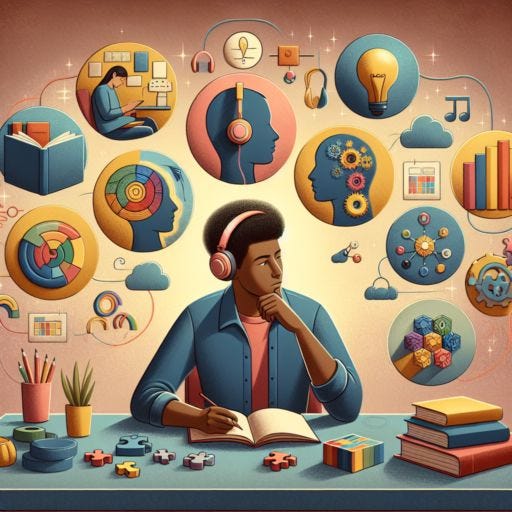
The Cognitive Filter Concept
Everyone processes information through unique neural pathways developed through personal experiences and biological predispositions. This mental filtration system:
Determines what information gets prioritized (e.g., visual learner noticing infographic patterns first)
Affects emotional connection to material (auditory learners feeling energized by group discussions)
Influences long-term retention rates (kinesthetic learners remembering procedures they've physically performed)
Why it matters: Recognizing your filter helps you strategically select learning modalities that align with your neural wiring, which is particularly crucial when acquiring complex skills like surgical techniques or data analysis.
The Four Lenses of Engagement
Visual-Spatial Lens:
Strength: Rapid pattern recognition (critical in interpreting medical imaging or coding structures)
Challenge: May overlook textual details in favor of big-picture visuals
Professional Impact: Essential for architects, surgeons, and data visualization specialists
Linguistic Lens:
Strength: Precise communication of complex ideas (vital for patient education or technical writing)
Challenge: Can overcomplicate visual concepts with verbal descriptions
Evolution: From traditional textbooks to interactive e-learning modules
Logical-Structural Lens:
Strength: Systematic problem-solving (key in treatment protocol development)
Challenge: May struggle with abstract concepts lacking clear frameworks
Tech Synergy: Naturally aligns with algorithm-based learning platforms
Experiential Lens:
Strength: Embodied knowledge integration (crucial for physical therapy techniques)
Challenge: Requires more time-intensive learning methods
Modern Adaptation: Virtual reality surgical simulations
The Attention Economy Paradox
In our information-saturated world:
Visual learners gravitate toward infographic-heavy platforms like Instagram
Linguistic learners dominate long-form content platforms like Medium
Logical learners thrive in structured MOOC environments like Coursera
Experiential learners fuel the TikTok/YouTube tutorial economy
Reader Takeaway: Understanding your lens helps you navigate this landscape without cognitive overload, which is particularly important when learning about complex health topics or new technologies.
4. Neuroplasticity and Lens Evolution
Our learning preferences aren't static:
Post-50 cognitive changes often enhance pattern recognition (benefiting visual learners)
Trauma or health changes can shift dominant lenses (e.g., chemo brain requiring multimodal approaches)
Technology integration is creating new hybrid lenses (AR visual-logical learners)
5. Practical Implementation Framework
Diagnostic Mirroring: Use smartwatch data to track which learning formats maintain optimal heart rate variability
Cross-Training: Pair dominant lens with secondary modality (visual + kinesthetic for surgical training)
Environmental Design: Curate learning spaces that support your lens (auditory learners using spatial audio setups)